

What if the most distinctive kitchen isn’t inspired by a particular look, but by the way you live? Luxury bespoke kitchens can be difficult to picture in a real home when inspiration images show only polished finished rooms. A striking scheme also needs to work around your routines, your space and the details you rely on every day.
Start with a clear brief, not a fixed style. This guide explores how layout, materials, finishes and considered joinery can come together to create a kitchen that feels personal and practical. You’ll find ways to turn ideas into choices that suit your home, understand what craftsmanship and customisation can involve, and identify questions to raise with a specialist. Ravenswood Joinery is a family-run manufacturer with over 30 years of industry experience, offering bespoke kitchens, timber joinery and professional spray finishing. These capabilities may inform a project, but the focus here is on the decisions that matter to you.
Key Takeaways
- Begin with your routines and the atmosphere you want, so the kitchen brief reflects your household rather than a preset look.
- Use traditional, contemporary and mixed-period references to identify details that suit your home without treating any style as a fixed package.
- Compare materials and finishes for appearance, upkeep and feel, then consider how each will stand up to everyday use.
- Explore how luxury bespoke kitchens may offer tailored dimensions and joinery details, and weigh these against the defined choices of standardised ranges.
- Prepare measurements, room photographs, inspiration references and everyday priorities to make your discussion with a joinery specialist more focused.
Luxury bespoke kitchens start with the way you live
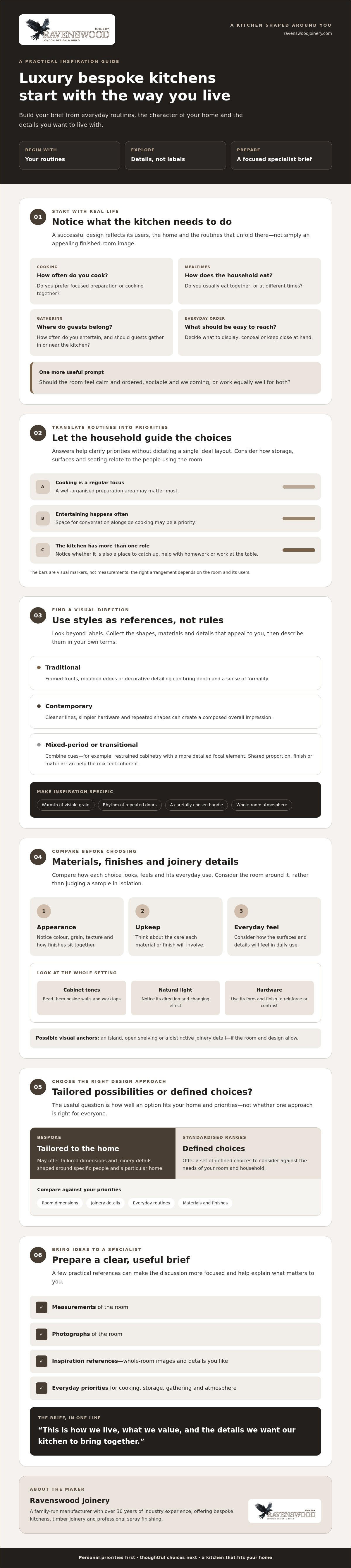
Luxury is personal. A successful kitchen reflects the people who use it, the character of the home and the routines that unfold there, rather than simply reproducing an appealing image. A bespoke kitchen is a design shaped around specific people and a particular home. Everyday life is a practical place to begin gathering inspiration.
Before choosing a look, consider what you want the room to feel like and how it needs to work:
- When and how often do you cook? Do you prefer focused preparation or cooking together?
- Do you usually eat as a household, or do mealtimes happen at different times?
- How often do you entertain? Should guests gather in the kitchen or nearby?
- What do you want on display, concealed from view or easy to reach?
- Should the room feel calm and ordered, sociable and welcoming, or work equally well for both?
Your answers help clarify priorities without dictating a particular layout. A keen cook may value a well-organised preparation area, whilst a household that entertains often may want space for conversation alongside cooking. Family meals, quick breakfasts and relaxed shared use can each call for different relationships between storage, surfaces and seating. The right arrangement depends on the room and its users, not on a single ideal plan.
Which everyday moments should shape your kitchen inspiration?
Notice what happens during an ordinary week, not only on special occasions. Is the kitchen mainly a place to cook, or does it also become a spot for catching up, helping with homework or working at the table? Think about the utensils and ingredients you reach for often, and whether clutter tends to gather on open surfaces. As you collect references, save whole-room examples that capture an atmosphere as well as close-ups of finishes or details.
How can a kitchen feel distinctive without feeling out of place?
Look at the home’s architecture and proportions before settling on a strong visual direction. A compact room, a generous open-plan space and a home with prominent period details each provide different design cues. The kitchen also needs to sit comfortably alongside adjoining rooms, so note their colours, materials and lines. For a broad overview of the room’s changing role and practical functions, see this kitchen design reference.
Continuity doesn’t mean matching everything. Repeating a material, colour or detail can connect cabinetry with the wider room, whilst a contrasting feature can give the kitchen its own character. Rather than relying on claims that one style is timeless, judge ideas by how well they suit your home and remain meaningful to you. That personal relevance is a stronger foundation for distinctive design.
Find luxury bespoke kitchen inspiration in style, character and atmosphere
Style references are useful starting points, not fixed packages to reproduce. As you explore luxury bespoke kitchens, look beyond labels such as traditional or contemporary. Notice the details that give a room character: the shape of a cabinet front, visible grain, the feel of the hardware and the balance between quiet surfaces and focal features. A gallery of luxury kitchen inspiration can help you compare visual directions. The most useful references, though, are those you can describe in your own terms.
What visual details distinguish traditional, contemporary and transitional kitchens?
Traditional rooms may use framed fronts, moulded edges or decorative detailing to create depth and a sense of formality. Contemporary schemes often favour cleaner lines, simpler hardware and repeated shapes for a composed overall impression. A mixed-period or transitional approach can bring these cues together, perhaps pairing restrained cabinetry with a more detailed focal element. The combination feels coherent when details share a common thread, such as proportion, finish or material.
Rather than saving an image simply because you like it, note what appeals: the warmth of visible grain, the rhythm of repeated doors, or the contrast between a plain surface and a carefully chosen handle. This turns browsing into a more precise brief.
How can colour and focal features work together?
Colour is affected by its surroundings. Cabinet tones can look different beside a pale wall, a textured surface or a contrasting worktop. The amount and direction of natural light also shape how the room reads throughout the day. Hardware adds another layer: its finish and form can reinforce a traditional character or provide a subtle contrast against simpler fronts.
An island, open shelving or a distinctive joinery detail may serve as a visual anchor, if the room and design allow. The aim is to give the eye a point of interest without making every surface compete. Build a moodboard that records both the reference and the reason you chose it:
- Atmosphere: calm, warm, formal or sociable.
- Visual detail: colour, grain, hardware or cabinet-front shape.
- Relationship: what complements the room, and what provides contrast.
Before settling on a finish, view suitable samples in the intended room and compare them with your references in different natural light. A discussion with a joinery specialist can help you explore how visual preferences may translate into made-to-measure details. Ravenswood Joinery’s bespoke kitchen work provides a starting point for considering those possibilities.
Compare materials, finishes and joinery details before choosing a look
A kitchen’s character comes from the way its components work together. Timber, painted surfaces, hardware and cabinet proportions each affect the overall impression, but their practical demands matter too. Assess material, finish and joinery detail together, because each influences how the others look and feel in your home.
Use this comparison as a starting point, not a specification. The appearance and care needs of a particular surface depend on the material and finish selected, so ask for product-specific guidance before making a decision.
What should you compare when considering kitchen materials and finishes?
| Option | Appearance and feel | Upkeep and household suitability |
|---|---|---|
| Timber | Can bring visible grain and a tactile, natural character. The look varies according to the timber and treatment used. | Ask how the proposed surface should be cleaned and maintained, and whether its appearance will suit the way the kitchen is used. |
| Painted or spray-finished surface | Offers a more even visual field, with the final impression shaped by the selected colour and finish. | Confirm the options and care guidance for the particular finish. Check how marks, handling and ordinary cleaning should be managed. |
Lighting can change how colour and texture read. View samples in the room, beside wall finishes and work surfaces, and consider them in the natural light available at different times. Ravenswood Joinery offers professional spray finishing. Ask which options are available for the kitchen you’re considering and what maintenance each requires. Avoid relying on broad claims about durability or repair unless they’re supported by information for the specific product.
Where does bespoke joinery make a visible difference?
Look closely at cabinetry proportions, the alignment of fronts and how edges meet walls, corners or adjoining materials. Made-to-measure elements may help address the particular dimensions of a room, whilst consistent detailing can make a scheme feel composed rather than assembled from separate decisions. Discuss the details that matter to your brief and confirm which cabinetry options and finishes are available.
For further space-planning ideas, explore bespoke kitchen design that makes every part of your space work harder. You can also read this perspective on luxury bespoke kitchens as you consider how tailored cabinetry and material choices contribute to a finished room.
Are luxury bespoke kitchens worth considering over standardised options?
Not automatically. A bespoke kitchen is worth exploring when its flexibility answers a specific need, but it isn’t the right route for every household or project. Standardised ranges can suit rooms where their set dimensions, defined cabinetry choices and included scope meet the brief. Compare how well each proposal responds to the home, the desired finish and the work you actually need, rather than relying on the “custom or standard” label.
With luxury bespoke kitchens, the potential advantage lies in tailoring elements to particular dimensions or design priorities. That may matter in a room with awkward proportions, or where a specific joinery detail is central to the scheme. If standard options already fit the space and preferences, additional customisation may not provide meaningful value. Let the brief determine whether made-to-measure work solves a real problem, rather than assuming bespoke is inherently better.
When might a bespoke kitchen be the better fit?
Consider where standard dimensions or a limited choice of details could constrain your plans. Perhaps a room has an unusual shape, or you want cabinetry proportions and joinery details aligned with the character of the home. Write down the outcome you’re seeking, then ask whether custom work would achieve it more effectively. A clear, specific requirement is a stronger reason to consider bespoke manufacture than the label alone.
What questions help compare kitchen proposals fairly?
First, establish what each provider is responsible for. “Bespoke” may describe the cabinetry, but it doesn’t necessarily mean every part of the project is included. Ask for the scope in writing, then compare proposals on an equivalent, itemised basis rather than relying on a headline figure.
- Scope: What is designed, manufactured, finished and installed, and which tasks sit with you or another provider?
- Specification: Which materials, finishes, cabinetry details and other components are explicitly included?
- Practical arrangements: Who confirms measurements, coordinates the work and handles any changes? Check what is agreed rather than making assumptions.
- Evidence and terms: Can the provider share relevant examples of workmanship? What aftercare, if any, is stated in the proposal?
Ravenswood Joinery is a family-run specialist manufacturer with over 30 years of industry experience and offers bespoke kitchens. If you’re comparing made-to-measure joinery with standardised options, review the team’s bespoke kitchen information and confirm which project stages are included.
Bring your luxury bespoke kitchen ideas to a specialist joinery brief
A useful brief turns inspiration into decisions a joinery specialist can respond to. It needn’t be a finished design. Gather what you know about the room and your household, separate firm priorities from open questions, and use the discussion to clarify what may be possible. This keeps the conversation grounded in your home rather than in images alone.
What should you prepare before speaking to a kitchen joiner?
Start with how the kitchen needs to serve you. Note regular routines, the atmosphere you hope to create, storage frustrations and essential features. Add photographs of the room from several viewpoints, along with measurements you have taken. Label measurements as approximate unless they’ve been professionally confirmed, and record features that may affect the layout, such as openings, visible details or awkward corners.
Bring a considered selection of inspiration. Annotate each reference with what appeals, whether that’s cabinet proportions, a material contrast or the overall mood. This is more useful than a collection of images without context. Include questions or constraints that still need investigation instead of guessing at technical requirements.
- Daily priorities: How you cook, eat, gather and use the room.
- Room information: Photographs, available measurements and features to discuss.
- Design direction: References marked with the details and atmosphere you like.
- Open questions: Choices, constraints and practical matters that need confirming.
How does Ravenswood Joinery fit into a bespoke kitchen conversation?
Ravenswood Joinery is a family-run specialist manufacturer with over 30 years of industry experience. Its capabilities include bespoke kitchens, timber joinery and professional spray finishing, which may be relevant when discussing cabinetry, joinery details and finishes. Confirm specific timber species, cabinetry options and finish choices directly rather than assuming they are available based on general inspiration.
Before progressing, ask the provider to clarify what its proposal covers. Design, manufacture, finishing and installation may involve different responsibilities. Confirm who will establish or verify measurements, which materials and details are included, and what stages sit outside the quoted scope. Clear answers help you understand how your brief will be taken forward and which decisions remain yours.
For ideas on the process, visit Ravenswood Joinery’s bespoke kitchen information.
Shape your kitchen around what matters to you
The strongest kitchen ideas begin with the people and home they’re intended to serve. Use your routines to guide the layout, collect inspiration for the atmosphere and details you value, then assess materials, finishes and joinery as a connected whole. Bespoke isn’t automatically right for every project, so compare proposals by their specified materials, responsibilities and included work, not by the label alone.
For those considering luxury bespoke kitchens, Ravenswood Joinery brings over 30 years of industry experience as a family-run specialist. Its offering includes bespoke kitchens and specialist timber joinery, with professional spray finishing among its services. Discuss your priorities and confirm which options and project stages are available for your brief.
Frequently Asked Questions
What makes a kitchen truly bespoke?
A truly bespoke kitchen is shaped around a particular household, home and brief, rather than selected solely from a fixed set of standard dimensions and options. The degree of customisation can vary, so clarify which elements are made to measure and which are standard components. Ask how the proposed cabinetry, joinery details and finishes respond to your room and priorities, and confirm exactly what the provider will manufacture.
Are luxury bespoke kitchens worth considering compared with fitted kitchens?
Luxury bespoke kitchens may be worth considering if tailored dimensions or specific joinery details address a real need in your home. A fitted kitchen with defined sizes and options may suit a room and brief that align well with its range. Compare the proposals’ specifications and responsibilities, including what is manufactured, finished and installed. Bespoke isn’t automatically the better choice; suitability depends on the project and the scope offered.
How do I choose a style for a bespoke kitchen?
Start with your home’s architecture, the rooms adjoining the kitchen and the atmosphere you want to create. Then identify visual details that appeal, such as framed cabinet fronts, clean lines, visible grain or particular hardware. Collect a few references and annotate what you like about each, rather than trying to reproduce a whole room. This gives a joinery specialist a clearer direction whilst leaving room to adapt ideas to your home.
Which materials and finishes work well in a luxury kitchen?
The right choice depends on the appearance, feel and upkeep you want, as well as how the kitchen is used. Timber can bring visible grain and a natural character, whilst painted or spray-finished surfaces offer a different visual effect. Ask about cleaning, maintenance and repair for the specific products proposed, and view samples in your room’s lighting. Ravenswood Joinery offers professional spray finishing; confirm which kitchen finish options are available.
Can a bespoke kitchen suit a period or modern home?
Yes, a bespoke approach can be considered for either, provided the choices respond to the building and the household. In a period home, you might explore proportions and detailing that sit comfortably alongside existing character. In a modern interior, simpler lines or restrained repetition may feel more appropriate. Neither direction is compulsory: discuss the room’s features, adjoining spaces and preferred atmosphere before deciding on details.
What should I prepare before speaking to a bespoke kitchen company?
Prepare photographs of the room, any measurements you have, inspiration references and a concise list of daily priorities. Include routines, storage frustrations and features you consider essential. Annotate images to show which details appeal, such as a finish or cabinet proportion. Also note uncertainties, including constraints that need checking, rather than guessing at technical requirements. Ask the provider to confirm which stages and responsibilities are included in its proposal.
How do I compare quotes for a bespoke kitchen without focusing only on price?
Compare itemised proposals by their scope and specification, not just their totals. Check what is designed, manufactured, finished and installed, which materials and cabinetry details are included, and what is excluded or left to you. Ask how changes are handled and whether aftercare terms are stated. You can also request relevant workmanship examples and clarify who is responsible for each project stage before deciding which proposal best matches your brief.


